
What a 30-Year AI Expert Wants Every Business Leader to Know
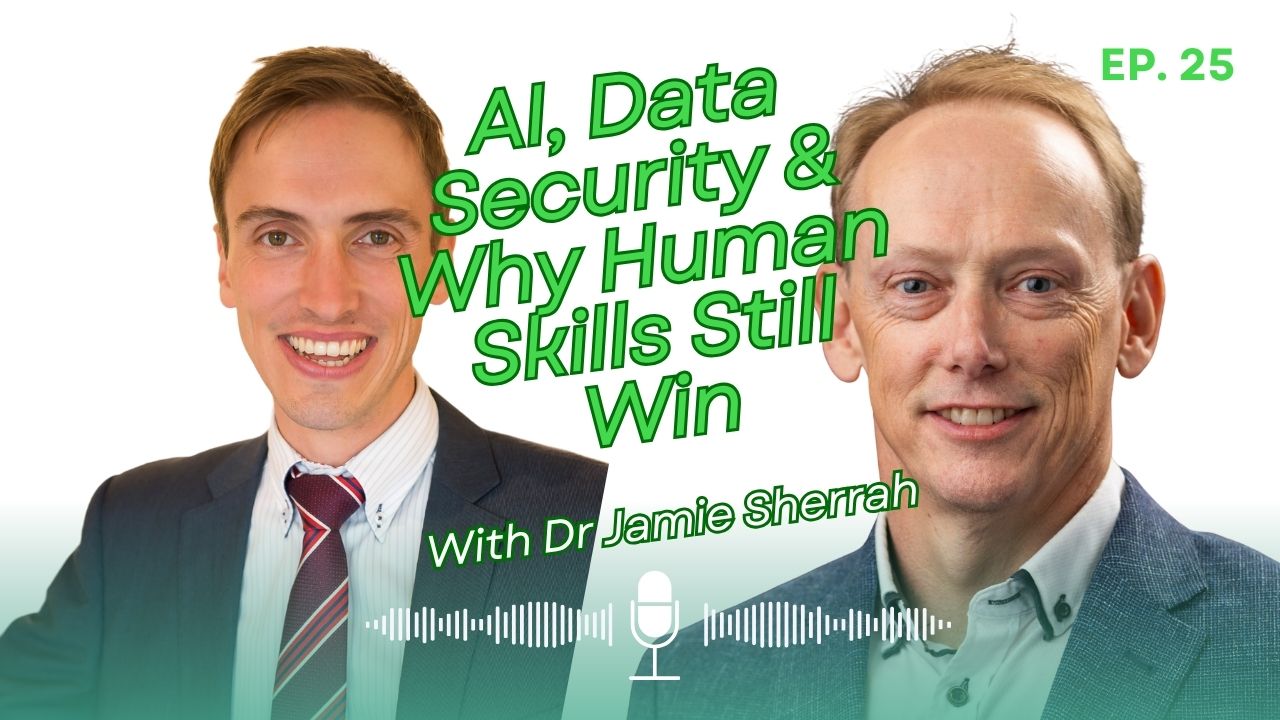
Most of us came to AI through ChatGPT. We copy-pasted something in, got a result that surprised us, and then started wondering what else it could do.
Jamie Sherrah has been in this world since the nineties.
PhD in machine learning. Neural networks. Computer vision. Defence research. Hedge funds. And now his own company, Inject AI, building custom AI systems for industries ranging from hospitals to the resources sector. When Jamie talks about artificial intelligence, he's not summarising a LinkedIn post. He's lived it.
I had the privilege of sitting down with him on the Energize With Bram podcast, and what came out of that conversation is something I think every business leader needs to hear.
AI isn't "always learning" — and that matters
Here's a misconception that surprised me: most people think AI is constantly getting smarter in the background. It's not. You train a model, and then that model is essentially fixed. The illusion of memory you get in tools like ChatGPT comes from the software layer around the model, not the model itself. The AI is the engine. The application is the car.
Why does this matter for you? Because it changes how you think about the tools you're using. You're not building a relationship with an AI that's evolving to understand your business. You're working with a very capable — but static — tool that needs clear input to give you useful output.
The data security problem most businesses are sleepwalking into
This was the part of our conversation that I think will hit hardest for corporate leaders.
When you use an overseas AI platform, your data leaves your boundary. For many businesses, that's a manageable risk. But for anyone in law, finance, healthcare, or defence, it's a liability. Jamie pointed out that tools like GitHub Copilot have quietly started defaulting to training on your private code — unless you actively switch that off. If you missed that notification, your proprietary IP may already be contributing to someone else's model.
His practical advice: check every AI tool you're using for a "train on my data" setting and turn it off. Separate your sensitive and non-sensitive use cases. And before you give any AI integration the ability to write data — send emails, update records, push files — think hard about where that data ends up.
The SaaS Apocalypse and what it means for your business
Jamie introduced me to a term I hadn't heard: the SaaS Apocalypse. It refers to the recent stock market hit to software companies, triggered in part by the realisation that general-purpose AI tools like Claude can now do things that used to require specialised (and expensive) software subscriptions.
But here's the nuance — and it matters if you're choosing tech for your business. The companies with real staying power aren't the ones doing basic data processing. They're the ones with deep domain knowledge baked into how they handle data. If a software company is only moving information around, yes, AI will eat their lunch. But if they've built years of industry-specific logic into how they calculate, organise, and secure your data — that's a moat.
Know the difference before you cancel a subscription or build something from scratch with a vibe-coding tool.
Why people skills are your competitive advantage — not your consolation prize
I saved the best for last, because this is where Jamie's answer surprised me the most.
I asked him directly: as AI takes over more of the doing, how do people skills protect someone's career? His answer was pragmatic and honest. AI won't replace your job. Someone who uses AI well will replace your job. But there's a ceiling on what AI can do autonomously — and that ceiling is held up by human judgment, accountability, and the ability to orchestrate.
You still need the architect. The person who knows what good looks like. The person who can read a room, build trust, and make a decision with incomplete information.
In every industry, Jamie said, someone needs to quality-control the output, keep it on-brand, check the assumptions, and be accountable for the result. That person isn't going away. If anything, they're becoming more important.
That's what Communication Mastery is built for.
Not soft skills. Not theory. Practical, applied communication that makes you more effective in the moments that count — whether you're leading a team, running a client conversation, or presenting to a board.
AI is changing the game. The people who win will be the ones who are both fluent in the tools and trusted in the room.
Listen to the full episode with Jamie Sherrah wherever you get your podcasts, or watch on YouTube.
AI can write the email. It can't read the room.
The leaders who do well over the next decade won't just be the ones who automate fastest — they'll be the ones who pair that speed with sharper human skills: reading people, building trust, communicating with influence. That's the entire premise behind Communication Mastery.
👉 See how Communication Mastery works
Want more conversations like this one? Subscribe to Energize With Bram wherever you listen.
